The large number of carved rocks revealed by a fire on the Fylingdales Moor (near Robinhoods Bay) in 2003 was ‘big news’ at the time. However 10 years later the carvings have mostly merged back into the landscape as grass and heather have re-covered the moors.
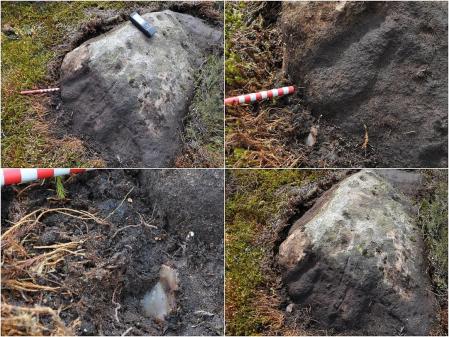
A recent visit to the area provided an opportunity to check up on a few ‘old friends’ on the moor, but en-route some eroded cup marks on another rock caught my attention, as i knew there were no carvings listed for that location. A closer inspection revealed 5 or 6 cup marks on top of the boulder and 2 vertical grooves on its east side.
Deciding it was worth a photograph, i trimmed back the vegetation, however the side with the channels remained covered. Pulling back a clump of the heather revealed a piece of white flint at the base of the rock, just in front of the channels. This stopped me in my tracks – might this be a flint tool? Perhaps even one used in connection with the carvings?
I could only see the top part of the flint, but this was something of a dilemma – should i leave it in place and report it to the relevant authorities or should i remove it for ‘safe keeping’? After some pondering, i photographed the flint in situ and then lifted it out of the soil.
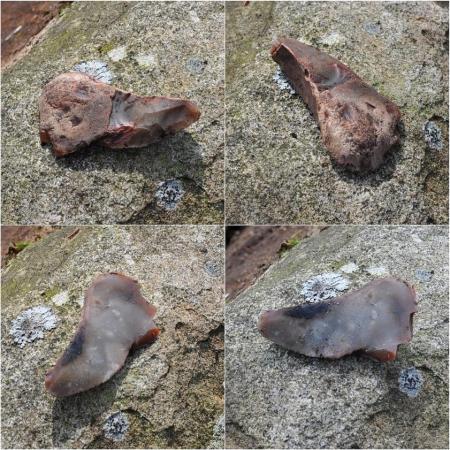
Potentially this was an important discovery and i did not want to risk it being ‘pocketed’ by a curious passer-by (… a slim chance perhaps, but stranger things have happened on these moors, – a story for another time perhaps). Lifting the flint confirmed that it was indeed a worked piece with a cutting edge and a pointed end. The discovery has been reported to the National Park archaeologist and the flint is to have an experts eye cast over it.
The pointed end of the tool has been worked, so it is possible that it had been used to ‘peck’ the carvings, but just as easily the tool could have been used to cut something on the boulder or even simply dropped there by accident.
In its favour, the flint did ‘look’ like it had been left there intentionally – the pointed end being pushed into the earth. It was very close (almost touching) the base of the rock and it was also in front of the carved grooves on that face of the rock. Raising the possibility that the flint was left there on purpose as part of some activity taking place at this carved rock.
This might sound like pure speculation, but a similar situation has been noted at some Scandinavian sites, where worked flints were deposited at the base of carved rocks. Closer to home, flints have been found on several carved rocks in Scotland, for example
http://megalithix.wordpress.com/2011/06/26/corrycharmaig-3/)
While pieces of quartz have also been found deposited in the crevices at other Scottish sites and a similar explanation has also been suggested for the occurrence of worked flint in small ‘clearance’ type cairns.
So there we have it, quite interesting, quite exciting, and perhaps another piece in the jigsaw?


 Posted by Halikeld





 British Rock Art Blog